
Key Takeaways:
- A massive, unprotected workforce: Southeast Asia's gig workforce runs into the tens of millions and remains largely outside formal social protection. Indonesia alone counts an estimated 4 million app-based drivers, while Malaysia's Department of Statistics puts its active delivery rider population at roughly 370,000.
- The catastrophe protection gap: Insurance penetration across most ASEAN markets sits below 10%. The gap is starkest in countries with the largest gig workforces: the Philippines' catastrophe protection gap is estimated at 98%, while the UNDRR reports climate insurance coverage in Indonesia, Vietnam, and the Philippines all sit below 1% of GDP.
- The double exposure of weather: A rider who cannot safely work through a monsoon flood or heavy downpour loses income immediately. There is no wage floor, and traditional indemnity products are not built to replace this highly specific, high-frequency loss.
- The parametric advantage: Parametric rainfall and flood cover is structurally suited to this gap. Payouts trigger automatically based on measured rainfall rates or flood depths at the rider's location, requiring zero claims filing or loss adjustment.
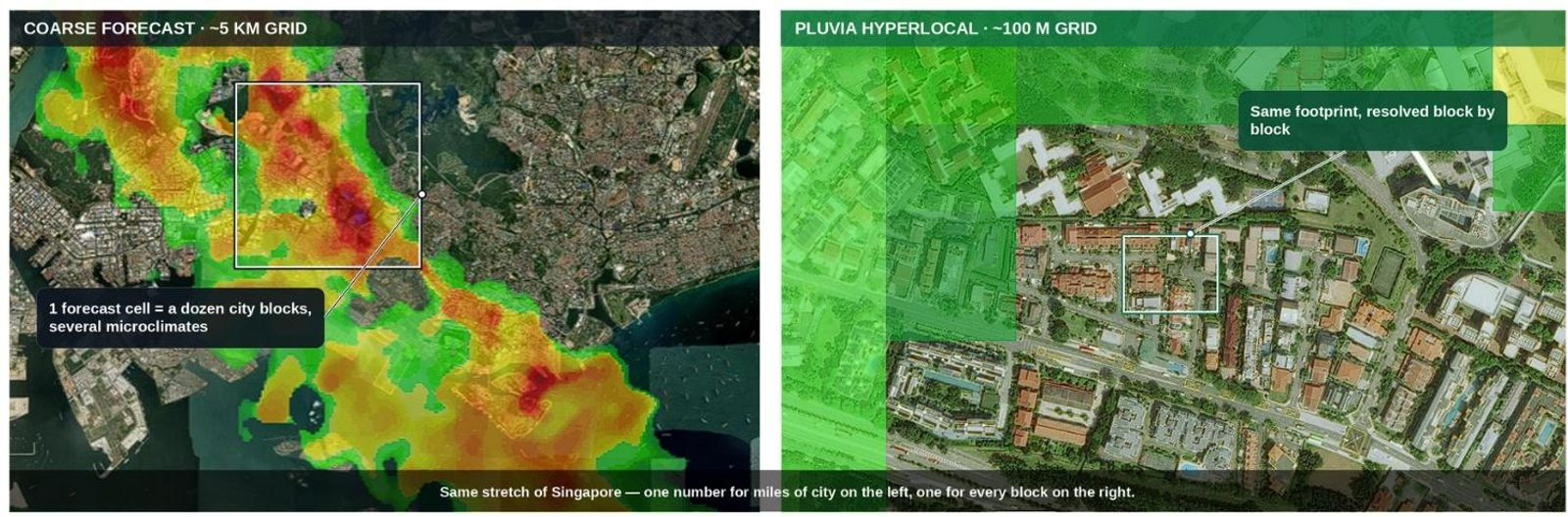
- Solving "Basis Risk" with resolution: Standard 5km weather grids fail parametric models because they trigger false positives and negatives. Feeding 100m-resolution rainfall data into a trigger engine via API allows insurtechs to price and settle policies based on the individual rider's actual work zone.
Southeast Asia's gig economy runs on an unyielding mathematical reality: riders are paid by the trip, not by the hour. For the millions of e-hailing drivers and food delivery riders navigating the streets of Jakarta, Manila, Bangkok, and Kuala Lumpur, a day they cannot safely work is a day of income that simply disappears.
Existing gig-worker insurance and platform benefits across the region almost exclusively cover personal accident (PA) and third-party liability. Yet, the most frequent disruptor to a gig worker’s livelihood isn't a traffic collision—it is the weather. A sudden, intense tropical downpour or a localized flash flood simply makes the job impossible, or entirely unsafe, to execute.
This coverage gap is becoming a focal point for regulators and insurtechs alike. Regional governments are moving to formalize gig-worker protections, such as Malaysia's recent Gig Workers Act and mandatory Self-Employment Social Security Scheme (SKSPS) contributions. However, these frameworks focus on retirement and severe injury. They do not address weather-driven income loss—a near-annual, highly predictable event for any rider working through a monsoon or typhoon season.
Closing this gap requires a completely different approach to product design. It requires moving away from traditional indemnity claims and embracing hyper-local parametric triggers.
1. The Coverage Gap: Riders Are Exposed to Weather Twice
To understand the necessity of this product, insurtechs must understand the double-sided exposure gig workers face during extreme weather.
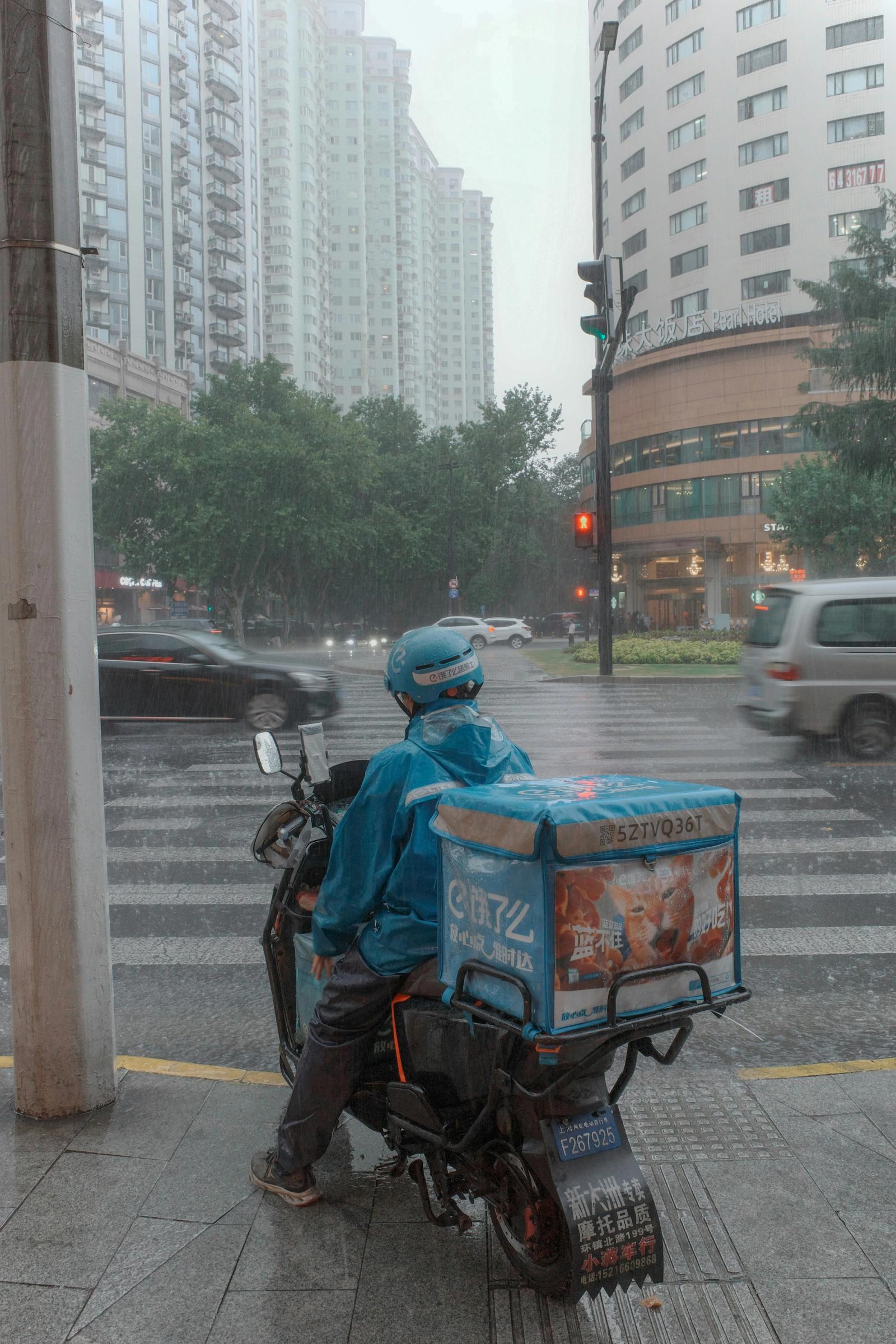
Physically, riding a motorcycle through flash flooding or a heavy convective downpour is genuinely dangerous. Visibility drops to near-zero, road traction is severely compromised, and hidden hazards beneath floodwaters lead to severe accidents. Recognizing this, most platforms' own safety guidance actively encourages riders to stop, pull over, and wait out the storm.
Financially, however, stopping carries a severe penalty. Because there is no employer-side buffer or minimum wage floor to absorb the downtime, a two-hour wait under a bridge is a total loss of peak earning hours.
This micro-economic crisis is a symptom of a macro-level vulnerability. According to the UNDRR's Global Assessment Report and data from the ASEAN Secretariat, insurance penetration across most ASEAN markets sits below 10%. The catastrophe protection gap in the Philippines alone is estimated by GlobalData to be roughly 98%. When catastrophic weather hits, it hits an informal, self-employed workforce that has absolutely no financial safety net to fall back on.
2. Why a Traditional Claims Model Fails the Gig Economy
If the problem is obvious, why hasn't the insurance industry solved it? The answer lies in unit economics.
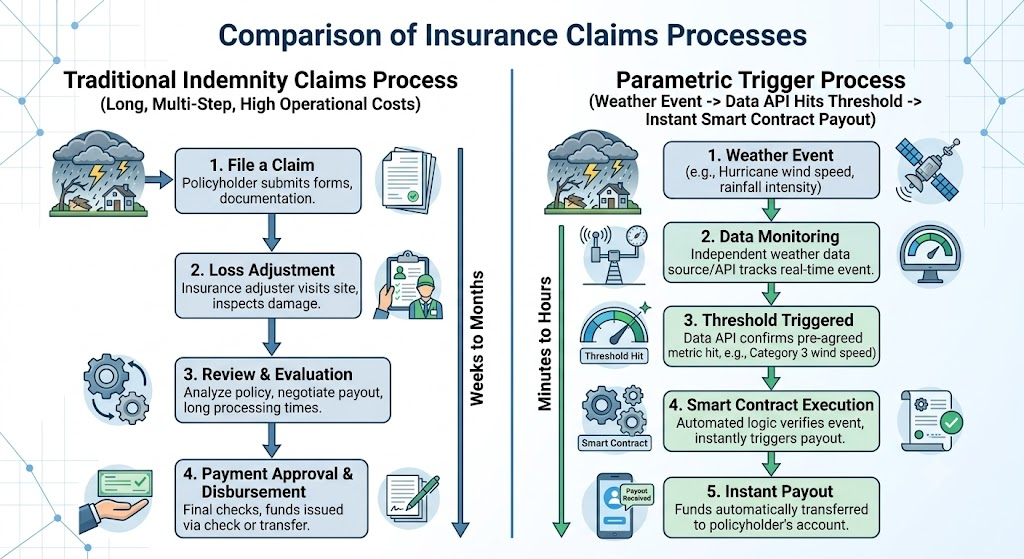
A conventional indemnity claim involves a multi-step process: the insured files a claim, submits documentation (proof of lost income, proof of weather), a loss adjuster assesses the validity, and eventually, a settlement is dispersed. The administrative cost of processing this traditional claim is often higher than the payout itself would be worth for a single rider's lost $15 to $30 shift.
At the volume and speed at which a gig platform operates, that cost structure does not scale. Traditional indemnity models are designed for low-frequency, high-severity events (like a house burning down). Gig-worker weather disruption is the exact opposite: a high-frequency, low-severity event.
Parametric insurance structures completely remove this mismatch. As outlined in Howden Group's parametric methodology, in a parametric model, the payout depends entirely on an objective, measured data point (a "parameter") crossing a pre-defined threshold—such as >40mm of rain falling within a one-hour window in a specific postal code.
Because the parameter acts as the absolute source of truth, there is no investigation. There is no loss adjustment. There is no claims form. The cost per policy drops exponentially, creating a product that can actually function at gig-economy volumes and micro-premium price points.
3. The Enemy of Parametric Design: Basis Risk
While parametric insurance solves the unit economics problem, it introduces a different challenge: Basis Risk.
Basis risk is the risk that the parametric trigger does not accurately match the actual loss experienced on the ground.
- Negative Basis Risk: A rider is stranded in a flooded street, losing income, but the insurance doesn't pay out because the designated weather station 10 kilometers away didn't record enough rain.
- Positive Basis Risk: The insurer pays out because a regional weather station recorded massive rainfall, but the specific zone the rider was working in remained completely dry.
In Southeast Asia, where rainfall is driven by highly localized convective storm cells rather than massive, uniform weather fronts, basis risk is the single largest hurdle to parametric adoption.
If an insurtech relies on standard global weather APIs—which typically deliver data in coarse 1km to 5km grids or rely on single airport weather stations—the product will fail. A 5km resolution obscures the exact corridors where riders are operating. It leads to disputed triggers, frustrated platform partners, and inaccurate actuarial pricing.
4. Designing a Trigger That Matches Reality (The 100m Solution)
To eliminate basis risk, the trigger must match the reality of the rider's immediate environment. This is where hyper-local, high-resolution data becomes the backbone of the product.
By leveraging a purpose-built API like Pluvia rAIn API, which delivers weather and flood predictions at a 100m × 100m spatial resolution, insurtechs can evaluate risk at the street level. At 100 meters, the API can confirm conditions at the rider's specific registered zone or live GPS ping.
Furthermore, the trigger design must reflect how gig work stops. An official "Flood Warning" issued by a national meteorological agency is useless for a parametric trigger, because those warnings are heavily generalized and often issued hours after the rain has actually forced riders off the road.
Instead, embedded-insurance teams should design short-window rainfall-rate thresholds. A trigger set to fire when >25mm of rain accumulates within a rolling 60-minute window perfectly captures the intense, localized downpours that destroy a lunch-rush shift.
5. Structuring Payouts Around a Shift, Not a Claim
Because this product represents income replacement rather than property damage, the natural unit of coverage is the affected shift or affected day.
The workflow is highly automated:
- A rider opts into the micro-insurance program through their delivery app (e.g., paying a few cents per shift).
- The rider logs in and begins their shift in a specific zone (e.g., Quezon City, Metro Manila).
- A torrential downpour hits. The Pluvia API detects that the 100m grid cell encompassing the rider's zone has crossed the predefined 40mm/hr rainfall threshold.
- The smart contract automatically executes.
- A pre-agreed payout (e.g., $15 to cover the lost shift earnings) is routed directly into the same digital wallet the platform uses for the rider's standard trip earnings.
This transforms a weather disaster from a week-long bureaucratic headache into a seamless, same-day digital experience. The rider receives a push notification: "Heavy rain detected in your zone. It is unsafe to ride. We have credited your wallet for the lost shift. Stay safe." This level of care drives massive loyalty and retention for the platform, turning insurance from a begrudged expense into a highly visible, daily benefit. (This is not theoretical—leading regional platforms like Gojek already utilize Pluvia's 100m data to optimize surge pricing and fleet shifts; wiring that same data to an insurance wallet is the natural next step).
6. Integration: What Actuarial Teams Actually Need to Know
Every market in Southeast Asia has a predictable seasonal risk window. Malaysia has the Southwest and Northeast monsoons; Thailand and Vietnam experience distinct wet seasons; the Philippines manages a brutal typhoon season; and Indonesia faces archipelago-wide monsoon shifts.
A trigger-based product allows actuaries to price around these seasons rather than treat them as unpredictable chaos. The integration point for an actuary building this product relies on robust historical data.
Before pricing a pilot, actuarial teams can use Pluvia to pull years of hyper-local, 100m-resolution historical rainfall data for specific delivery zones. By overlaying this data with the platform’s historical trip volume, actuaries can back-test the proposed triggers: If we set the threshold at 30mm/hr, how many times would this have paid out last November in South Jakarta? This allows insurtechs to dial in their premiums and thresholds with scientific precision, ensuring the product is profitable for the underwriter, affordable for the rider, and highly responsive to actual weather events.
7. What Insurtech and Platform Teams Should Do Now
The technology to protect gig workers from climate disruption is no longer hypothetical. The data resolution, the API infrastructure, and the digital wallet rails all exist today.
For insurtechs and embedded-insurance providers looking to capture market share in Southeast Asia, the opportunity is massive. The first movers to offer a frictionless, weather-triggered income protection product will not only tap into a market of tens of millions of underinsured workers, but they will also solve one of the most persistent retention challenges faced by gig platforms today.
The monsoon season will arrive. The only question is whether your product will pay out when it does.
About Pluvia: Pluvia.ai provides hyper-local weather and flood prediction APIs purpose-built for Southeast Asia. Our platform delivers 100-metre resolution, 2-minute refresh rates, and physics-informed AI, validated against national agencies like Singapore's PUB. Contact us to see how our hyper-local historical and live data can power your next parametric income-protection product for gig and platform workers.
Call to action: Ready to price a pilot? Talk to us about back-testing a hyperlocal rainfall trigger for your target market — [Contact Pluvia Support / Request API Key].