
Key Takeaways:
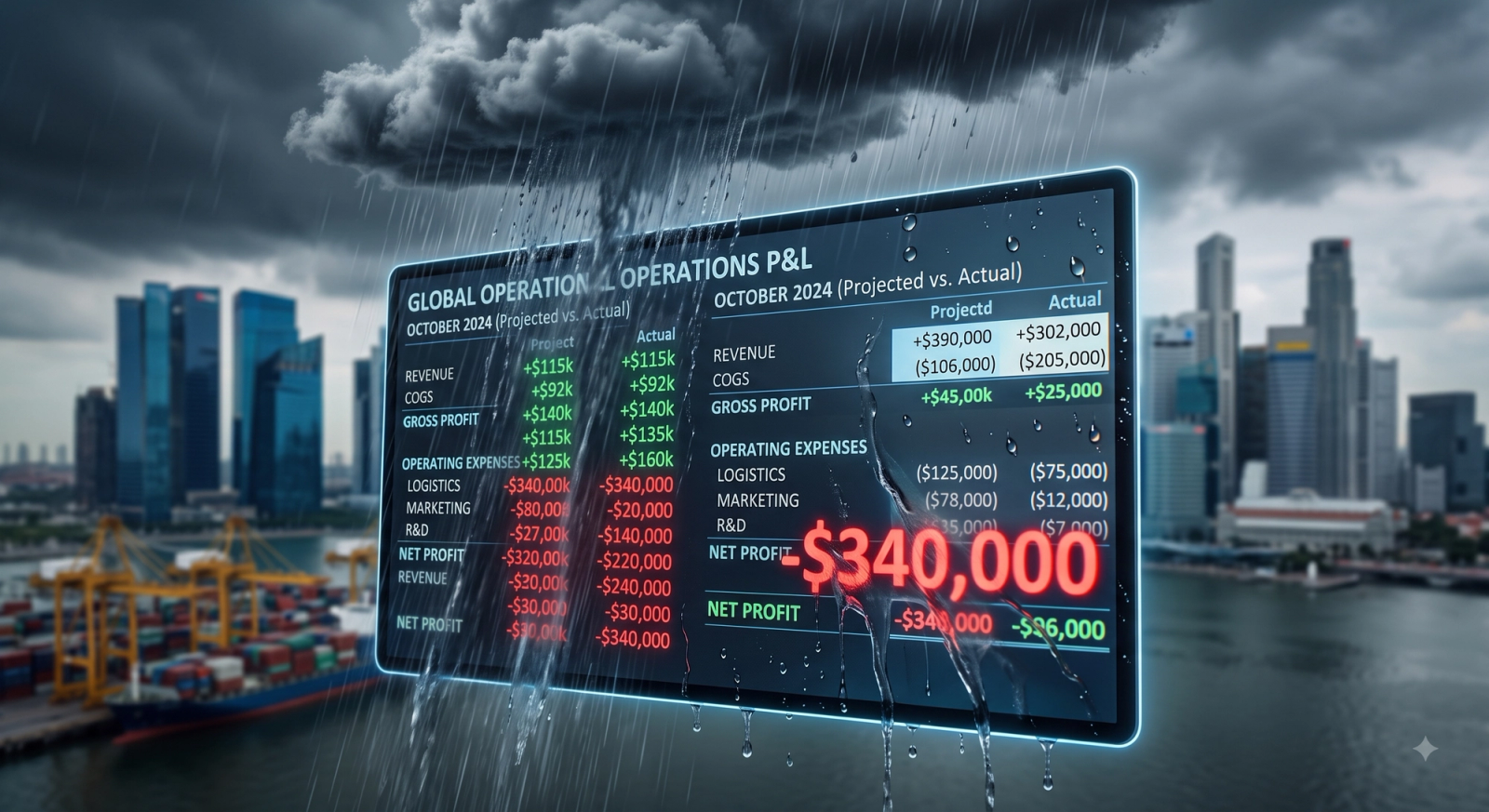
- The invisible drain: Weather cost is real but usually invisible, hidden inside generic "operations" and "customer service" budget lines rather than tracked as its own distinct category on a P&L.
- The scale is not hypothetical: Severe weather events are wiping out regional P&Ls. The 2011 Thailand floods caused roughly $46.5 billion in damages (disrupting 70% of the manufacturing sector). More recently, the devastating late-2025 monsoon season generated combined regional economic losses exceeding $20 billion across Southeast and South Asia.
- Concentration of risk: A small number of high-impact weather events typically drive most of the cost—meaning targeted, minute-level intelligence has massive, outsized ROI.
- The business case starts with tagging: You can't build a business case for better forecasting until you've measured what weather is currently costing you. Tagging weather-related incidents inside existing ops or ERP systems—rather than building a separate tracking process—is what turns "weather cost" from a vague feeling into a defensible number.
- The baseline penalty: In mature markets, the baseline penalty of weather is staggering. Weather is estimated to cause roughly 23% of all roadway delays in the U.S. (Federal Highway Administration)—a useful reference point for how much routine logistics cost weather likely accounts for in the even more volatile climates of Southeast Asia.
Ask most operations directors in Southeast Asia what weather costs them in an average quarter, and you will likely get a shrug and a rough guess: "Some delays, I guess. A few lost shifts." Ask them to actually total it up by pulling data from their ERP, and the final number is almost always exponentially larger than expected. Why? Because weather cost hides in categories that nobody labels "weather."
Southeast Asia's recent history makes the scale of that hidden cost impossible to dismiss as a rounding error. The historic 2011 Thailand floods didn't just cause local damage; they severed global supply chains, effectively shutting down the "factory of Asia" and causing an estimated $46.5 billion in total economic loss. The late-2025 monsoon season was equally brutal, with compound extreme rainfall events across Thailand, Malaysia, and Vietnam driving combined regional losses exceeding $20 billion.
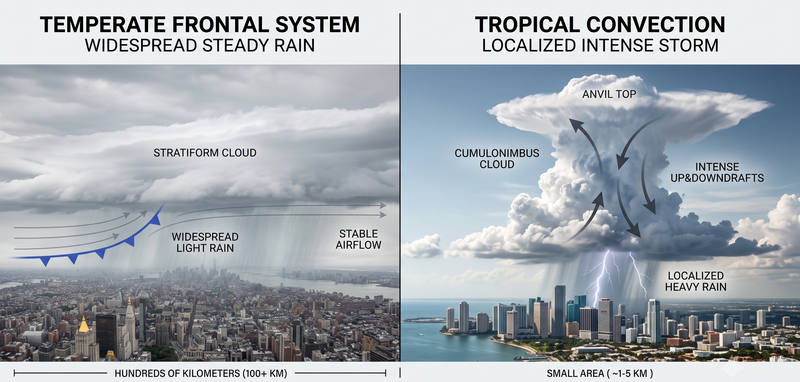
While these massive, named catastrophes make international headlines, it is the daily, grinding attrition of localized convective storms that slowly drains corporate P&Ls.
This tracking gap matters because it is self-perpetuating. If weather cost never gets its own line item in a financial review, no one ever builds the business case to invest in preventing it. The next flash flood, monsoon downpour, or lightning storm gets absorbed the exact same way the last one was: as an unplanned hit to whatever budget line happened to take the damage. Breaking that cycle starts with measurement, not with a new weather subscription.
1. Where the Cost Actually Lives
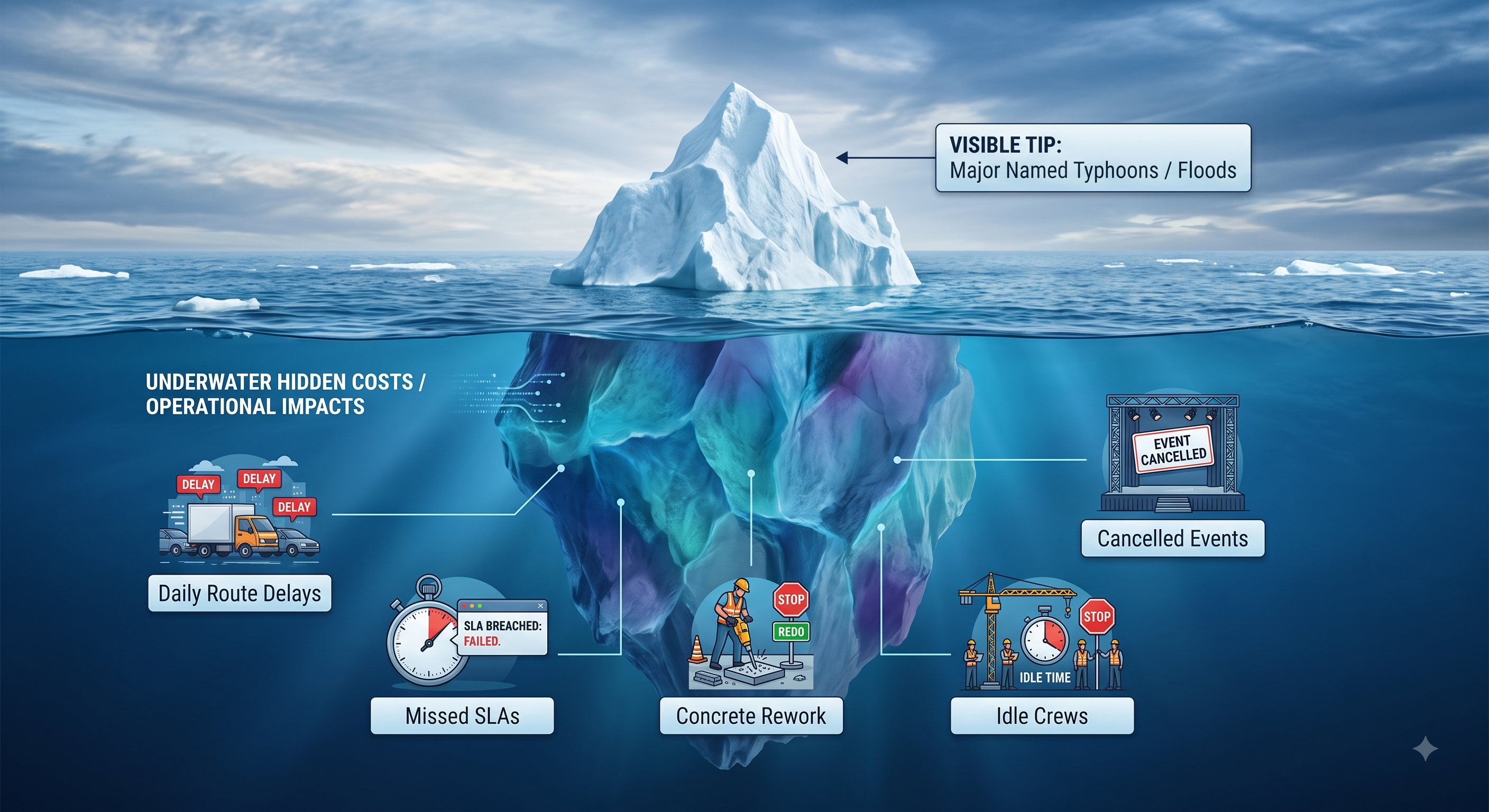
The categories look different across sectors, but the mechanism is exactly the same: weather doesn't just cause a single dramatic event, it taxes ordinary operations continuously.
- Logistics: The cost lives in slower delivery speeds, failed last-mile attempts, missed Service Level Agreement (SLA) windows with premium enterprise clients, cargo spoilage, and surge-related driver churn (when gig workers simply refuse to ride in a flooded zone).
- Construction: The cost lives in expensive rework from rain-damaged concrete pours, completely idle crews during stop-work periods, crane downtime due to unverified wind speeds, and cascading delays across subcontractors.
- Outdoor Events: The cost lives in last-minute cancellations, destroyed temporary infrastructure, massive refund processing fees, and the long-term reputational cost of a poorly handled, chaotic washout.
None of these line items show up on a monthly invoice marked "Weather." A failed delivery attempt gets logged as a "Service Issue." A rain-damaged concrete pour gets logged as "Material Rework." A cancelled event gets logged as "Refunds/Returns." Each incident represents real money bleeding out of the business, and each is currently completely invisible to the CFO or VP of Operations who is deciding whether a weather intelligence subscription is actually worth the cost.
2. Why It Stays Hidden (And How to Uncover It)
Because these costs get filed under "operations" or "customer service," the true weather-driven line item never surfaces in a quarterly P&L review. This makes it structurally difficult to build a business case for proactive forecasting—you cannot fix what you haven't measured.
Finance teams looking to build a case for a weather intelligence budget run into the same problem from the opposite direction. Because there is no existing account code to compare a proposed software spend against, the return on investment (ROI) looks abstract rather than concrete. Telling a CFO "We might avoid some delays" is a much harder sell than saying, "Weather-related incidents cost us $340,000 last quarter across these three specific logistics routes."
The fix isn't to build a massive new reporting system. The fix is a simple tag.
Most modern incident-tracking, ticketing, and ERP systems (like SAP, Oracle, Jira, or custom dispatch dashboards) already support custom categories. Simply adding a mandatory "Weather-Related" checkbox or tag to existing incident logs for a single season is usually enough to surface the pattern. You don't need to add headcount or buy new software; you just need to re-categorize the losses you are already recording.
3. Making the Case for Proactive Weather Intelligence
Once an operations team tags weather-related incidents for even one season, a specific, highly actionable pattern usually emerges: a small number of high-impact events drive a disproportionate share of the total cost.
Weather costs are rarely spread evenly across an ordinary rainy season. You will likely find that 70% of a team's weather-related financial drain came from just four specific severe events in the last two quarters.
This is a highly specific, testable claim that finance teams can act on. The business case for weather APIs isn't "better weather data in general"—it is "we need a system that catches those four specific events with enough lead time to respond differently next time."
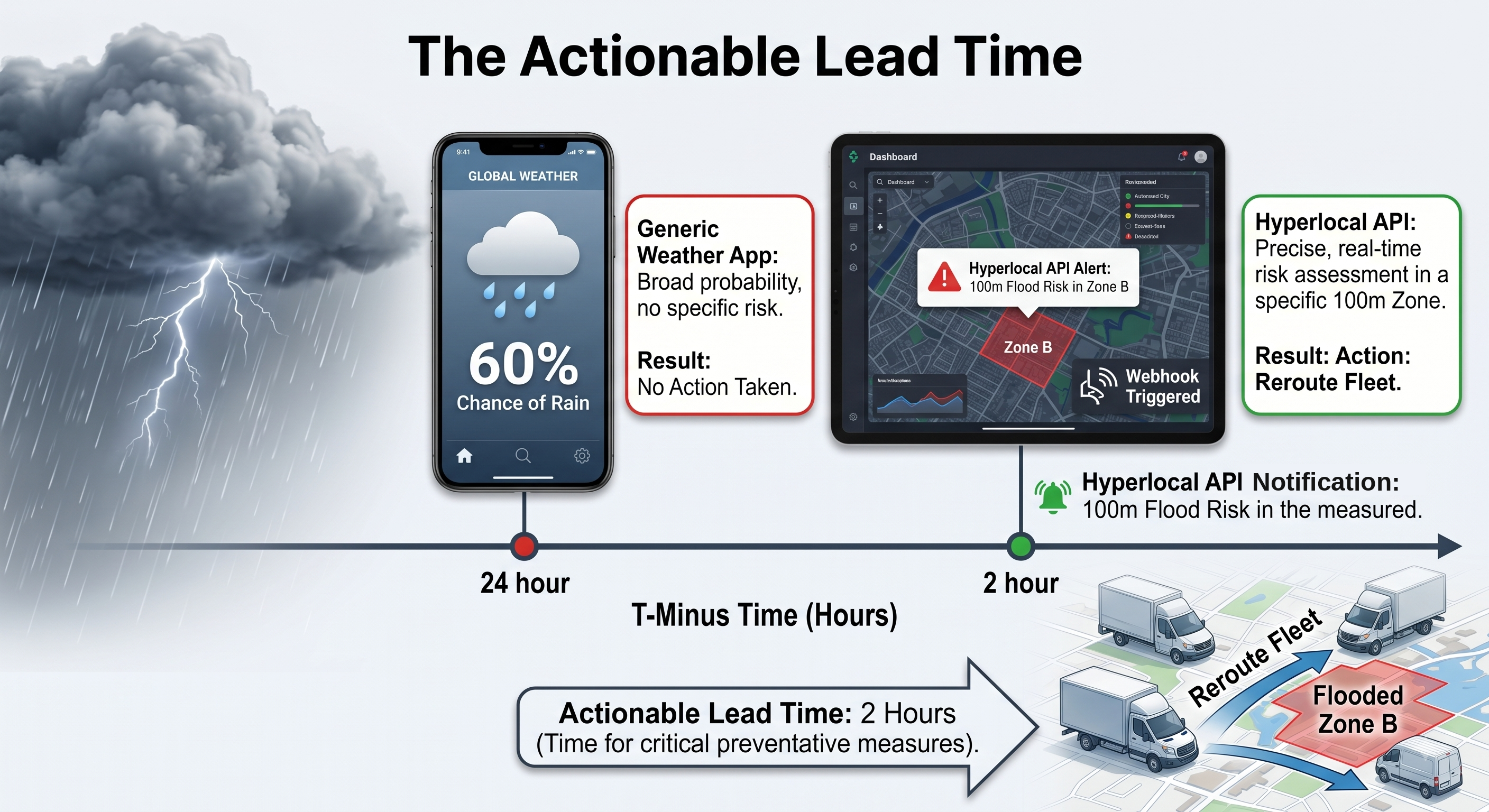
This is precisely the business case for hyperlocal, minute-level intelligence. A coarse, free global weather app usually did flag the general week as risky. What it completely failed to do was tell the dispatcher the specific 90-minute window when a specific delivery zone or construction site needed to stop, reroute, or reschedule.
4. Integration: What Finance and Operations Teams Actually Need to Know
Turning this into an ongoing practice, rather than a one-time audit, requires connecting your new weather data directly to the systems that already track your costs.
For companies adopting an API-first intelligence platform like Pluvia, the integration is seamless. By feeding Pluvia's 100m-resolution nowcasts and alerts into your dispatch or ERP system via webhooks, you can automate the tagging process. Every time an incident occurs in a zone where Pluvia has triggered a severe weather alert, the system automatically tags that delay or rework cost as weather-driven.
Furthermore, you don't have to wait a full season to build your baseline. By utilizing Pluvia's historical API endpoints, data science teams can pull past hyperlocal weather data and overlay it against historical incident logs. This allows you to build the business case retroactively, proving exactly how much extreme weather cost you last year.
For the ongoing monitoring piece, the same nowcast and 24-hour outlook feeds described elsewhere in this series feed a cost-avoidance model directly. Each stop-work call, driver reroute, or event reschedule triggered by a Pluvia threshold has a "cost avoided" metric attached to it. This is what eventually turns "weather intelligence" from a line-item expense into a documented, high-ROI return. Pluvia's API is designed to sit cleanly alongside existing incident and dispatch systems rather than replace them, meaning this correlation work does not require an expensive platform migration.
5. What Leaders Should Do Now
Start with measurement, not a software purchase.
Mandate that your teams tag weather-related incidents in whatever system already tracks your operations. Do this for one full season—a quarter at minimum—before evaluating any commercial weather intelligence vendor. That single, zero-cost step turns the business case for weather intelligence from a vague guess into a hard number specific to your exact operation.
Then, look for concentration. If a handful of specific storm events are driving most of your costs, prioritize a provider that can catch those exact event types with enough granular lead time to change the outcome. A slower-moving general improvement in forecast accuracy is worth exponentially less to your bottom line than a minute-level, 100m-resolution warning on the few events that actually matter.
The massive supply chain disruptions of the 2011 Thailand floods and the multi-billion dollar damages of the 2025 monsoon season prove the scale of the risk is real. The only question left is whether your organization chooses to measure its own exposure before the next storm hits—or after.
About Pluvia: Pluvia.ai provides hyper-local weather and flood prediction APIs purpose-built for Southeast Asia. We deliver 100-metre resolution and 2-minute refresh rates using physics-informed AI, allowing operations teams to act before the rain hits. Contact us at contact@pluvia.ai or visit pluvia.ai.
Call to action: Stop guessing what the monsoon costs you. Get a weather-risk audit that puts a real number on your operational exposure — Talk to Pluvia Today.